
- Health is your physical, mental and social well-being, while wellness is the ongoing work of supporting it.
- Wellness does not require perfect health, since people with a chronic illness can still pursue it.
- Canadian guidelines for adults aged 18 to 64 recommend at least 150 minutes of moderate to vigorous activity a week (Canadian Society for Exercise Physiology, 24-Hour Movement Guidelines, 2011).
Contents
- What Is Wellness and Health: A Clear, Practical Definition
- Wellness dimensions show how health, relationships and surroundings interlock
- Everyday wellness rests on habits and supportive conditions
- FAQ
People use health and wellness as if they meant the same thing.
What is wellness and health, really? Mixing them up makes it hard to know what to change in your routine. Below, we explain each term with simple, everyday examples.
What Is Wellness and Health: A Clear, Practical Definition
Health goes well beyond the absence of illness
The World Health Organization defined health in 1946 as a person’s physical, mental and social well-being. That definition came into force in 1948, when the organization’s Constitution took effect.
Being free of disease or injury is only part of the picture. You can have no diagnosed illness and still struggle with stress, loneliness, unsafe housing or other conditions that quietly wear down your well-being.
Wellness is something you build. It means making choices, forming habits and drawing on support to improve your health and quality of life. It covers your personal actions, your relationships and the conditions around you.
Health is your current physical, mental and social state, as in managing asthma while keeping up with daily activities.
Wellness is the ongoing set of choices and conditions that support well-being, such as taking medication, sleeping regularly and staying connected.
Well-being is how well you feel and function in your life. It means feeling safe, supported, capable and connected.
Health and wellness overlap without being the same thing. Health tends to describe a state or outcome. Wellness points to the continuing actions and circumstances that shape that state.
Turning the distinction into daily practice
Health care can prevent problems, catch them early, treat illness and support recovery. Wellness backs up these goals through everyday decisions, professional advice, social support and healthier surroundings.
Wellness does not require perfect health, since people with a chronic illness can still pursue it.
So a practical definition comes down to this. Health is your broader state of physical, mental and social well-being. Wellness is the ongoing work of supporting it.
Wellness dimensions show how health, relationships and surroundings interlock
Frameworks differ, and that is useful
Wellness models split well-being into dimensions. That lets you spot the areas that affect one another. Treat them as planning tools, not medical diagnoses or fixed rules.
Canadian frameworks often group these dimensions into three areas.
Individual health covers physical, mental and spiritual health. Personal life covers family, social and cultural connection, finances and the physical environment. Workplace covers physical and psychosocial conditions.
Workplace wellness rests on physical safety, workload, workplace culture and your relationships with colleagues and managers.
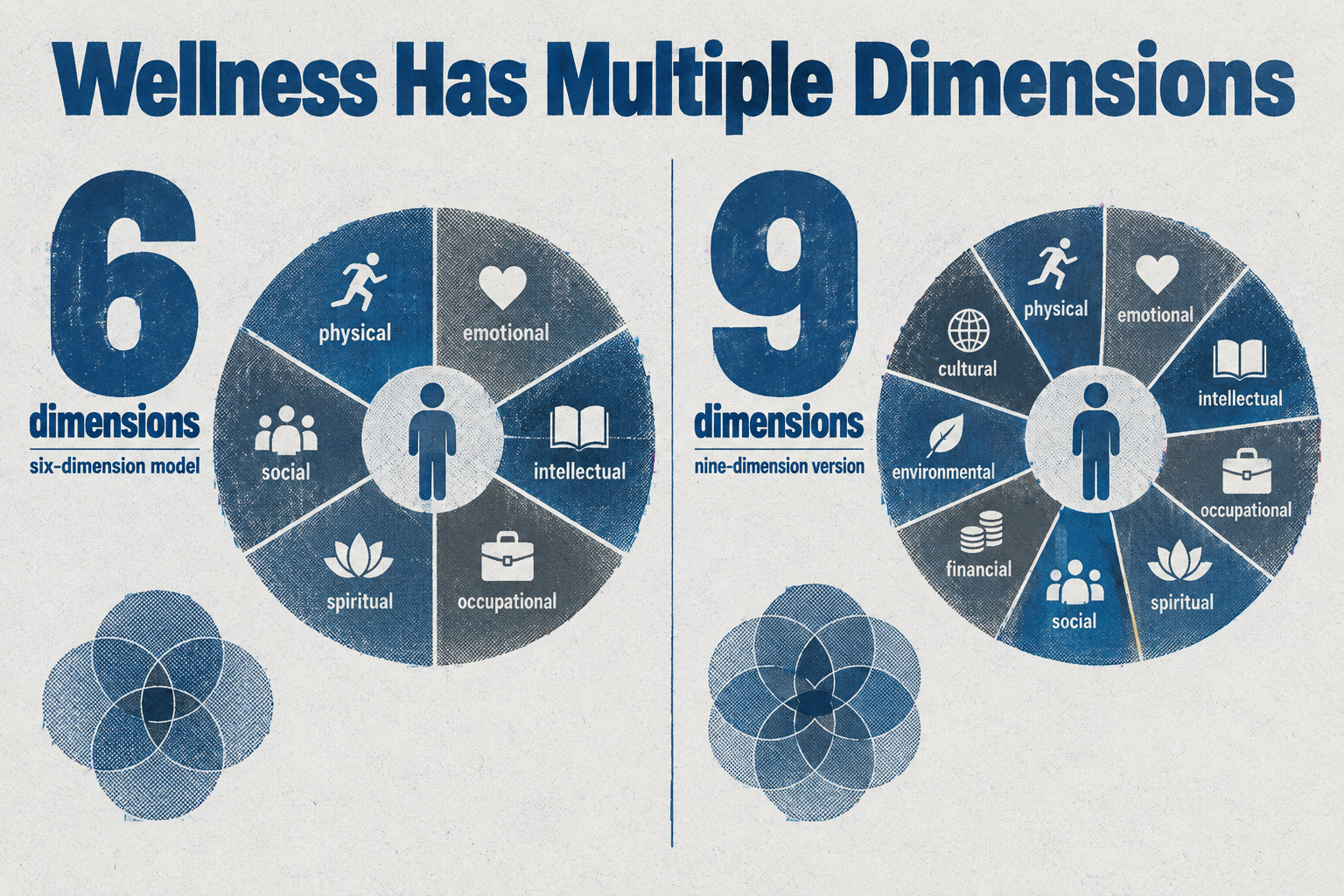
A six-dimension model usually covers physical, emotional, intellectual, occupational, spiritual and social wellness. A nine-dimension version may add financial, environmental and cultural wellness. The labels shift from one framework to another.
What each dimension looks like in real life
Each dimension names a distinct part of daily life. It can be your body, your mind, your money or your surroundings.
Physical wellness covers movement, nutrition, sleep, preventive care and attention to what your body needs.
Mental wellness means handling ordinary stress, recognizing your emotions, asking for help and using your abilities day to day.
Spiritual wellness is about meaning, purpose and values. It might take the form of religion, meditation, time in nature, service to others or decisions aligned with what matters most to you.
Family wellness is about relationships that are reliable and respectful.
Social and cultural wellness rests on a sense of belonging, ties to your community and respect for your own culture and those of others.
Financial wellness means understanding your money well enough to make practical decisions now and later. It doesn’t mean earning a particular income or never feeling financial pressure.
Environmental wellness covers the safety, noise, temperature, light, air quality and accessibility of the places where you live.
These dimensions don’t sit in separate boxes. They feed into one another. Financial stress can disrupt sleep, workplace conflict can weigh on mental health, and good social support can make it easier to manage an illness or change a habit.
Everyday wellness rests on habits and supportive conditions
Eating well
Canada’s Food Guide stresses vegetables and fruit, whole grain foods and protein foods. Plant-based proteins are chosen more often. It also suggests swapping saturated fats for unsaturated ones. Water should be your main drink.
A simple way to build a meal is to divide the plate, and fresh, frozen, canned and dried produce all have a place. Half the plate goes to vegetables and fruit, one quarter to whole grain foods and one quarter to protein foods.
Movement and sleep
Canadian guidelines for adults aged 18 to 64 recommend at least 150 minutes of moderate to vigorous activity a week (Canadian Society for Exercise Physiology, 24-Hour Movement Guidelines, 2011).
Several hours of light activity each day round out the picture. Sitting should not exceed eight hours per day.
Recreational screen time should stay at three hours or less.
Sleep is part of the same picture. Aim for seven to nine hours of good-quality sleep on a regular schedule.
Physical activity can lift your mood, sharpen your focus, boost your self-esteem and energy, and improve sleep. It can also ease worry, anger and sadness. Movement supports mental wellness as much as physical health.
Connection and everyday choices
Other practical steps include avoiding tobacco, limiting exposure to second-hand smoke, using the health services available to you and making room for supportive relationships. Quitting smoking reduces health risks at any age. It can also noticeably improve quality of life.
The 5-3-1 social-connection prompt offers a simple target. Connect with five different people or groups each week. Keep up three close relationships. Spend about an hour a day in meaningful interaction.
A safe home, clean air, affordable nutritious food, secure work and accessible public spaces make healthy choices far easier.
Poor housing, unsafe work or financial strain can create health risks. This can happen even when someone is doing their best to follow healthy habits.
Start by noticing which area of your life feels most neglected, whether sleep, finances or relationships, and make one small change there. The dimensions feed into one another, so a single step often eases the others too.
FAQ
Is there a single five-pillar model of health and wellness?
There is no single Canadian or international five-pillar model.
Common frameworks use six or nine dimensions instead. The right set depends on what you need the model for.
What are the seven types of wellness?
Seven types of wellness are not a universal standard.
Different models combine or separate areas such as emotional, physical, social, intellectual, occupational, spiritual, financial, cultural and environmental wellness. Check which list your program or framework uses.
Is wellness a medical diagnosis?
No, wellness is a broad way to think about habits and quality of life, not a clinical finding.
Wellness can support medical care but does not replace diagnosis or treatment. Only a clinical assessment can identify a health condition.