
Key takeaway: LPN to RN bridge programs accelerate career advancement by converting clinical experience into academic credits, shortening the path to an ADN or BSN. This transition expands professional autonomy and significantly increases median salaries. By choosing programs accredited by recognized bodies such as ACEN or CCNE, nurses support their licensure eligibility while significantly reducing redundant coursework through specialized testing-out mechanisms.
According to the U.S. Bureau of Labor Statistics Occupational Employment and Wage Statistics, Licensed Practical Nurses earn a notably lower annual salary than Registered Nurses, yet transitioning to an RN role can substantially increase this earning potential while opening doors to leadership. Online LPN to RN bridge programs provide a flexible pathway to achieve this advancement in as little as 18 to 20 months.
Many LPNs struggle to balance rigorous clinical requirements with their current work schedules. This guide breaks down how to select an accredited program that recognizes your prior experience, ensuring you choose the right ADN or BSN track to meet your career goals.
- Online LPN to RN Programs and the Bridge Transition
- Admission Standards for Modern Bridge Candidates
- Can I Complete Clinical Requirements at Local Facilities?
- Accreditation Verification and Financial Aid Strategies
Online LPN to RN Programs and the Bridge Transition
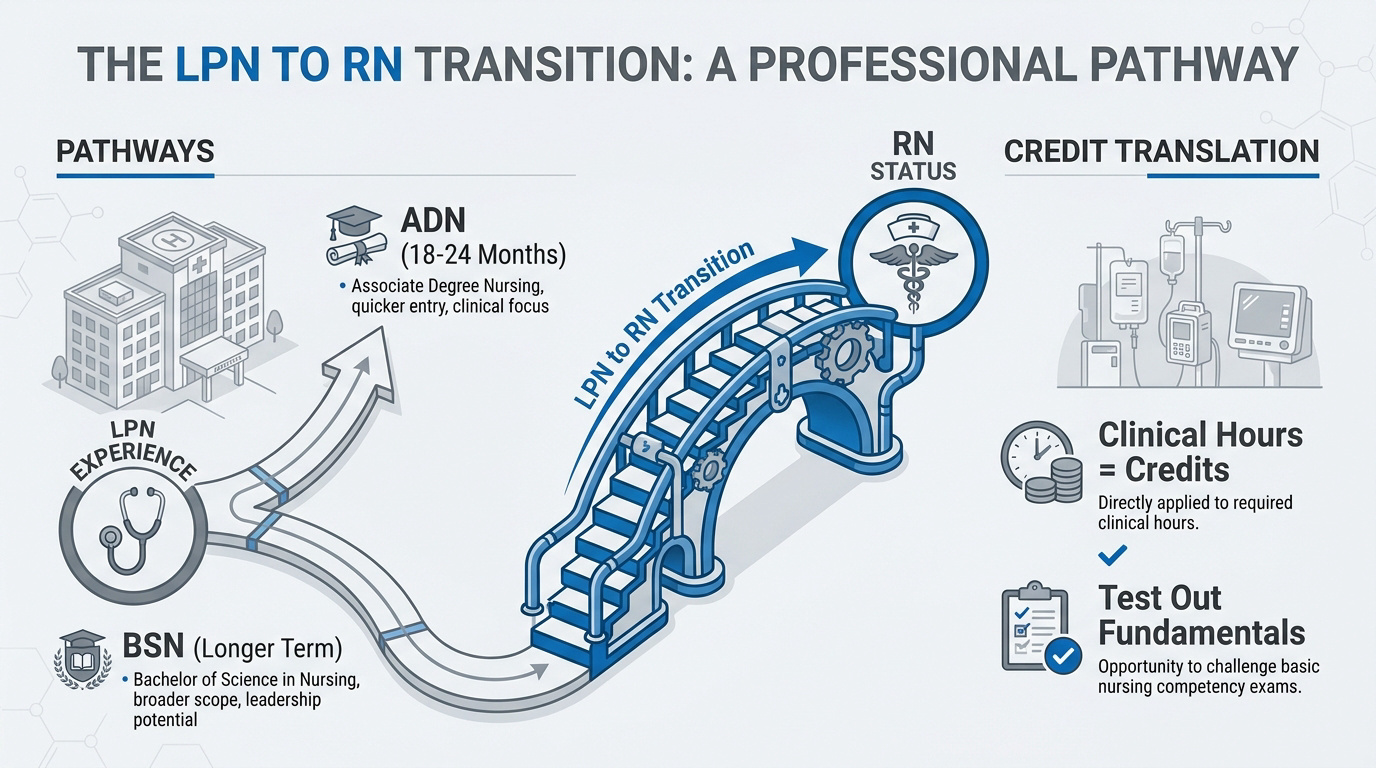
Bridge programs transition LPNs to RN status in 18 to 24 months via ADN or BSN pathways. Accreditation by ACEN or CCNE is mandatory for licensure. Clinical hours often convert to academic credits, significantly reducing coursework duration for experienced nurses choosing the ADN route.
Choosing the right path depends on your long-term goals and how fast you need to work. LPN to RN Bridge Programs Online: What to Expect and How to Choose often starts with a choice.
Choosing Between ADN and BSN Pathways
The ADN timeline usually spans 18 to 24 months. It is significantly faster than the BSN commitment. This path prioritizes a quick entry into the workforce. You focus on essential clinical skills immediately.
BSN holders generally access broader career opportunities, including leadership roles and higher pay scales. Specialized hospital units often require this four-year degree. The academic depth justifies the extra time spent.
Legislation like New York State’s “BSN in 10” law (enacted in 2017 and requiring newly licensed RNs to obtain a BSN within ten years of initial licensure) changes the game. This law heavily influences choices for regional nurses. It makes the BSN almost mandatory for long-term practice.
How Prior Nursing Experience Translates to Academic Credit
You can earn credits for completed clinical hours. Your work history acts as a substitute. It replaces basic bedside training requirements. This recognizes your existing expertise as an LPN.
Many programs use a “testing out” mechanism. Exams like HESI bypass introductory nursing fundamentals. You skip redundant 101-level courses entirely. This saves both time and tuition money.
The “Bridge” curriculum focuses on higher-level responsibilities. It shifts from task-oriented care to nursing diagnosis. You learn advanced care planning techniques. This transition is the core difference in RN duties.
Admission Standards for Modern Bridge Candidates
Moving from program selection to the application phase requires meeting strict benchmarks to ensure you are ready for the rigorous RN curriculum.
Licensure Status and Academic GPA Benchmarks
You must hold an unencumbered and active LPN license. This credential serves as the non-negotiable foundation for entry. No bridge program in the United States accepts candidates without it.
Reputable institutions in 2026 typically expect GPA minimums between 2.5 and 3.0. Competitive programs prioritize higher scores in science prerequisites. Anatomy and physiology grades are especially scrutinized by admissions committees.
Recent coursework is often a hard requirement. Many schools stipulate that science credits must be earned within five to seven years. Older credits may not remain valid for admission purposes.
Mandatory Entrance Exams and Background Screening
Standardized tests like the TEAS or NLN PAX are central to the selection process. These exams measure essential academic skills. They predict your potential for success in a fast-paced nursing school environment.
Updated criminal background checks and immunization records are mandatory. These steps ensure clinical placement eligibility. You must comply with state board of nursing regulations throughout the LPN to RN Bridge Programs Online: What to Expect and How to Choose process.
Professional references are the final piece of the puzzle. Most programs require letters from current nurse managers or clinical supervisors. These documents verify your professional competence and vital soft skills.
Can I Complete Clinical Requirements at Local Facilities?
Once admitted, the biggest logistical hurdle is often the clinical component, but modern distance education has streamlined this through local partnerships. Transitioning from a LPN to a RN requires hands-on practice that simply cannot be done through a screen.
Securing Local Clinical Placement Sites and Preceptors
Distance programs coordinate with hospitals near your home. Schools often maintain contracts with major healthcare networks. These agreements facilitate necessary rotations for remote learners. You won’t have to travel across the country for your training.
Ask your current employer for clinical hour verification. Your workplace might serve as a clinical site. This works if a qualified preceptor is available. It is a practical way to balance your job and education.
You must take charge of this process early. Most programs require students to identify potential sites. Do this in your first semester. Early planning prevents graduation delays and ensures a smooth “LPN to RN Bridge Programs Online: What to Expect and How to Choose” experience.
Integrating Virtual Simulation into the Nursing Curriculum
High-fidelity simulations handle specialized rotations like pediatrics. These digital scenarios create safe learning environments. You can practice complex decision-making without risk. It is a controlled way to master difficult clinical situations.
Digital labs meet specific state board requirements. Many states allow a percentage of hours via simulation. This does not compromise your licensure eligibility. It provides a flexible path for those in rural or underserved areas.
Success requires the right tech setup. You need reliable high-speed internet access. Specific software is mandatory for interactive modules. You will participate in real-time clinical sessions directly from your home office.
Accreditation Verification and Financial Aid Strategies
Ensuring the program’s legal standing is just as vital as securing the funds to pay for it, as both impact your future career stability.
Confirming ACEN or CCNE Accreditation Status
Attending an unaccredited program carries massive risks. You might not sit for the NCLEX-RN exam. Credits often fail to transfer to other schools. National bodies like ACEN or CCNE ensure your degree is actually recognized.
Verification is a simple but necessary step. Check your state board of nursing website. They maintain lists of approved distance programs. This confirms the school meets local criteria for licensure.
Regional accreditation for the university is also mandatory. It validates broad academic standards. Without it, you cannot access federal financial aid. It also protects the long-term value of your diploma.
Always review the program’s NCLEX-RN pass rates. High scores signal a strong curriculum. They show the school effectively prepares students. Low rates are a major red flag for any applicant.
Leveraging Employer Tuition Assistance and Nursing Scholarships
Many hospitals offer tuition reimbursement for their staff. They may provide thousands of dollars annually. In exchange, you commit to working as an RN. This strategy drastically reduces your personal debt.
Federal aid remains the primary funding source. Start by completing the FAFSA. This opens doors to Pell Grants. It also provides access to low-interest Stafford loans for eligible nursing students.
Private scholarships offer additional financial relief. Organizations like the ANA or NBNA provide targeted funds. Some programs specifically help minority nurses. Others support those working in underserved rural communities.
Don’t overlook education tax credits. The Lifetime Learning Credit is very helpful. It provides relief on out-of-pocket costs. This is perfect for working professionals pursuing a higher degree.
Earning your degree through accredited LPN to RN bridge programs online accelerates your transition toward higher pay and leadership roles. By leveraging clinical experience for academic credit, you can achieve licensure faster. Start your application today to transform your nursing career and secure a brighter professional future.
FAQ
How long does it typically take to finish an online LPN to RN bridge program?
The duration of your journey depends on the degree path you select. An Associate Degree in Nursing (ADN) typically requires about 18 to 24 months of study, while a Bachelor of Science in Nursing (BSN) generally takes between 28 months and four years to complete.
Many institutions allow you to accelerate this timeline by leveraging your previous experience. By validating prior credits or “testing out” of fundamental courses, experienced LPNs can often reduce the total time spent in the classroom.
Can I earn academic credit for my previous LPN work experience?
Yes, most bridge programs are specifically designed to recognize your prior learning and clinical expertise. Schools often grant academic credits for the clinical hours you have already completed as a licensed professional, which prevents you from repeating basic bedside training.
You may also be able to bypass introductory nursing courses through “testing out” mechanisms. Using exams like the NLN PAX or internal competency assessments, you can demonstrate your mastery of nursing fundamentals and move directly into advanced RN-level coursework.
What are the primary differences between the LPN and RN roles?
The transition to an RN role involves a significant shift from task-oriented care to advanced clinical judgment. While LPNs focus on essential patient care, RNs are responsible for complex nursing diagnoses, developing comprehensive care plans, and administering specialized medications.
As an RN, you will also take on greater leadership responsibilities and autonomy. This includes supervising other nursing staff and engaging in evidence-based practice to improve patient outcomes across various healthcare settings.
Are there specific accreditation standards I should look for in a program?
It is vital to ensure that any program you choose is accredited by either the Accreditation Commission for Education in Nursing (ACEN) or the Commission on Collegiate Nursing Education (CCNE). These credentials guarantee that the curriculum meets rigorous national standards for nursing education.
Attending an accredited school is often a requirement for sitting for the NCLEX-RN licensure exam. Furthermore, degrees from accredited institutions are more widely recognized by employers and are essential if you plan to transfer credits for a future advanced degree.
How do clinical rotations work for online nursing students?
While theoretical coursework is delivered online, you must complete hands-on clinical rotations at physical healthcare facilities. Many distance programs coordinate with hospitals near your residence or allow you to complete hours at your current place of employment under a qualified preceptor.
Modern programs also integrate high-fidelity virtual simulations into the curriculum. These digital labs allow you to practice complex decision-making in a safe environment and can often count toward a portion of your state-mandated clinical hour requirements.
What admission requirements should I prepare for?
Applicants must hold a valid, unencumbered LPN license and typically need a minimum GPA of 2.5 to 3.0. Many competitive programs also look for strong scores in science prerequisites, such as anatomy and physiology, completed within the last five to seven years.
You will also need to pass an entrance exam like the TEAS or NLN PAX and provide professional references. Additionally, expect to submit updated immunization records and undergo a criminal background check to ensure eligibility for clinical placements.
Are there financial aid options available for LPNs returning to school?
There are several ways to fund your education, starting with federal Pell Grants and Stafford loans via the FAFSA. Many healthcare employers also offer tuition reimbursement programs for LPNs who commit to staying with the facility as an RN after graduation.
You can also explore specialized scholarships from organizations like the ANA or HRSA, which often support nurses working in underserved areas. Additionally, the Lifetime Learning Credit may provide tax relief for working professionals paying out-of-pocket for their advanced degree.